How to Talk About Money Without Fighting
Money talks keep turning into fights? Learn how to talk about money without fighting, with six simple steps, sample phrases, and a check-in routine for couples.
Infinite Investor
6 min read

Money talks keep turning into fights? Learn how to talk about money without fighting, with six simple steps, sample phrases, and a check-in routine for couples.
6 min read
In this guide
It starts small. "Can we look at the budget?" Ten minutes later, you're not talking about the budget anymore. You're talking about who spends too much, who never plans ahead, and that thing from three months ago.
If that sounds familiar, you're not alone, and your relationship isn't broken. Most couples have never been taught how to talk about money together. The good news: it's a skill, and skills can be learned.
This guide is part of our Financial Compatibility in Relationships Guide. Let's break it down step by step.
Money is never just math. It carries your upbringing, your values, your fears, and your dreams. So when one of you says "we need to spend less," the other might hear "you're irresponsible."
That's why money conversations feel so hard. A few common reasons:
Naming what's really going on is the first step. And here's the hopeful part: handled well, money talks can bring you closer.
Most money fights aren't about money. They're about feeling heard.
Before you open a single bank statement, talk about the "why." What do you want your life together to look like?
When the conversation starts with a future you both want, the plan to get there feels like teamwork, not punishment.
Try saying: "If money weren't a worry, what would you want our life to look like in five years?"
Timing matters more than you think. Avoid money talks when either of you is stressed, right after a surprise bill, or in the middle of another disagreement.
Instead, set up a regular money date: coffee on a Sunday morning, a walk, or a quiet drink after the kids are in bed. Same time, low pressure, nothing urgent on the table.
Try saying: "Can we pick a time this week to talk about our plans? No pressure, just us and a coffee."

You can't build a plan together if part of the picture is missing. Share the full view: your income, your debts, your spending habits, and your credit score (a three-digit number lenders use to judge how reliably you've paid back money you've borrowed).
Hidden balances and secret spending are where trust breaks down. Honesty, even when it's uncomfortable, is where it gets rebuilt.
Try saying: "I want us to be on the same team, so I'm going to put everything on the table, including the parts I'm not proud of."
If you're worried something's being kept from you, our guide on how to spot hidden debt in a relationship can help you start that conversation gently.
A few simple rules keep the talk productive:
Try saying: "Help me understand why this is important to you."
Avoid: "You always waste money on..." Words like "always" and "never" put your partner on defense.
A budget is simply a plan for where your money goes each month. Budget arguments are often about control, so build one where both of you have a voice. Three parts make it work:
That last one matters more than it looks. Fun money gives you both freedom, so neither of you feels micromanaged. There's no right answer between a natural saver and a natural spender. Both of you bring something the plan needs.
A good budget doesn't pick a winner. It makes room for both of you.
 Infinite Investor
One big conversation won't fix everything. Small, regular ones will.
The more routine money talks become, the less charged they feel.

If the same fight keeps coming back, that's not a failure. It's a sign a neutral voice could help.
Asking for help is a sign you're both invested in getting this right.
Ask your partner for one 20-minute money date this week. Bring two things: a coffee and one question from Step 1. Don't open a single statement. Just talk about what you want your life together to look like.
That's it. You're not fixing everything in one sitting. You're getting on the same team, one conversation at a time.
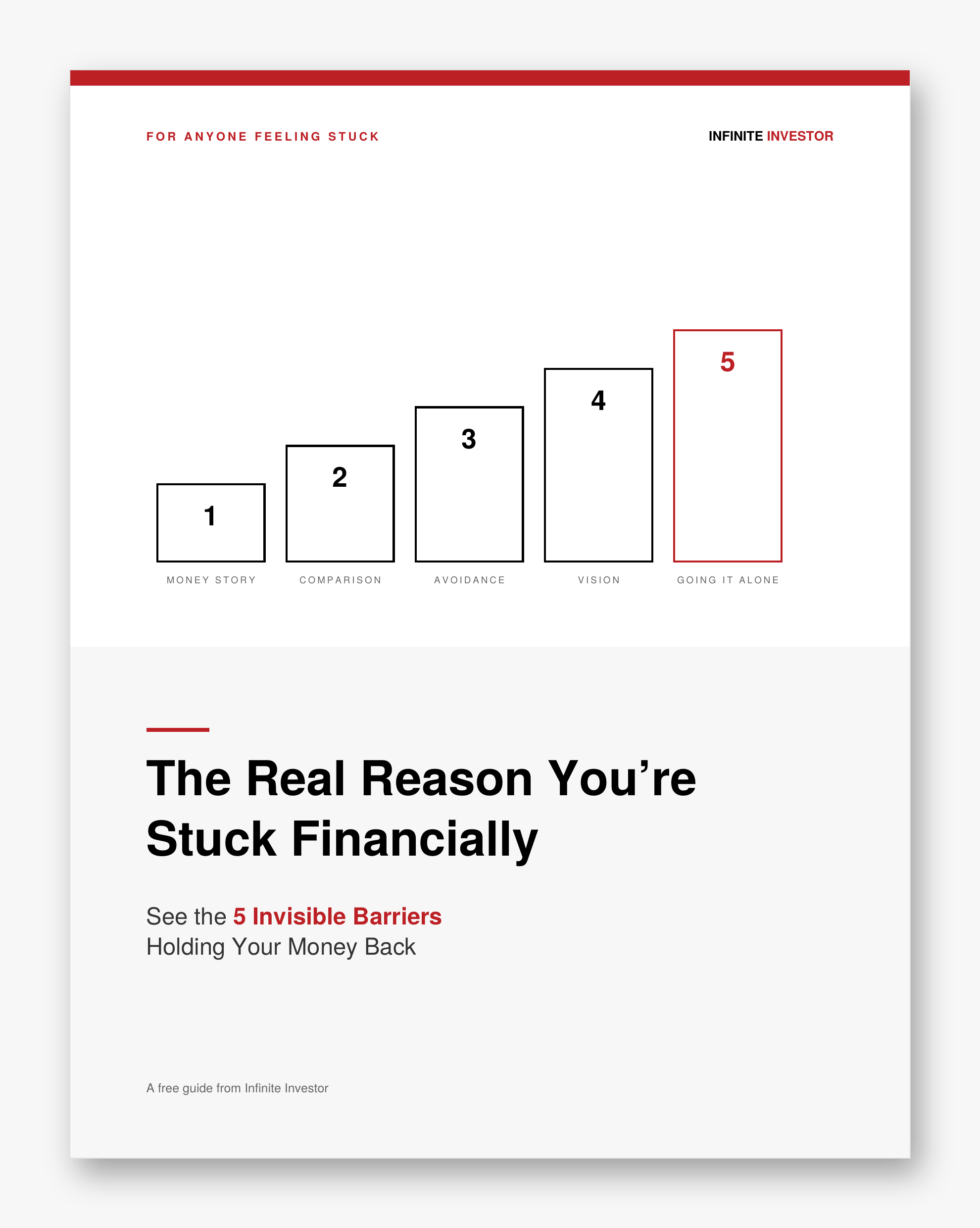
Haven't grabbed your copy yet? Download The Real Reason You're Stuck Financially and get the roadmap for free.